Beans on toast has risen 1,233% in price since 1996, driven by increases in staple ingredients like beans, bread and butter. It's the steepest rise of any dish in Updraft's Inflation Menu research, which tracked 100 popular UK meals against ONS ingredient price data.
Updraft’s research uncovers the UK’s favourite meals seeing the biggest spike in cost, with beans on toast coming out on top.
Beans on toast, one of Britain’s most cherished meals, has joined the ranks of the nation’s premium purchases. A staple meal which once represented national nostalgia and culinary simplicity now highlights a much bigger problem.
Since 1996, beans on toast has gone up in price by 1,233%. Meanwhile, 6.6 million Brits are relying on credit cards to cover essential grocery costs[1]. For many, dishes that were once the go-to now feel like a treat.
To better understand the extent of the issue, we analysed the UK’s top 100 dishes and mapped them against ingredient-level price rises to uncover which meals are becoming unexpectedly expensive – and which could soon be considered a luxury.
Beans on toast isn’t the only dish skyrocketing in price
With supermarket prices continuing to rise, what was once a cheap and cheerful meal for previous generations will now cost Brits almost ten times more.
| Meal | Price increase |
|---|---|
| 1. Beans on toast | 1233% |
| 2. Egg, chips & beans | 379% |
| 3. Fish & chips | 259% |
| 4. Spaghetti & meatballs | 156% |
| 5. Chilli con carne | 151% |
| 6. Garlic bread | 147% |
| 7. Pizza | 145% |
| 8. Tomato soup | 145% |
| 9. Lasagne | 127% |
| 10. Toad in the hole | 122% |
As old family favourites begin to feel out of reach, many households are forced to rely on credit cards and borrowing to cover the basics, turning the weekly food shop into a financial pain point and adding debt to the menu.
The nation’s beloved “chippy tea” set Brits back £2.27 in 1996 per 2 servings. Now, 30 years later, enjoying a classic fish and chips costs Brits a staggering £8.14, rising by 259%.
Even butter hasn’t escaped the inflation spotlight. The kitchen favourite has become a budget challenge, increasing from £0.84 per 250g in 1996 to £2.42 today, and becoming 187% more expensive.
It’s not just the finished dishes feeling the squeeze; some of Britain’s most shocking and expensive ingredients are surprisingly common items. From frying to baking, oil is the backbone of countless recipes, yet this cupboard staple has almost doubled over the years, rising from £0.50 per litre in 1996 to £1.95 in 2026 – a 290% increase.
Even butter hasn’t escaped the inflation spotlight. The kitchen favourite has become a budget challenge, increasing from £0.84 per 250g in 1996 to £2.42 today, and becoming 187% more expensive.
The shock prices hitting Britain’s dinner tables
Britain’s dinner tables are feeling the squeeze. Over the past decade, Median Equivalised Household Disposable Income of Individuals (total income of a household after taxes and benefits) has only gone up by just 5%, while the average cost of a classic British dish has jumped 33%. That’s the core problem: incomes are barely moving, but food prices are racing ahead.
As food prices have climbed by 50%[2] since 2021, 4 in 10 adults are reportedly spending more when food shopping to get what they usually buy[3]. Weekly food shops per person also went from an average of £23.1 to £30.7 within a decade for these dishes, meaning Brits effectively work 31 extra hours a year (almost a full working week) just to afford the same groceries.
Our data reveals a 284% gap between the average disposable income and the cost of Britain’s beloved beans on toast today.
Here’s where we come in
To highlight the severity of food inflation in the UK, we’ve launched our campaign, The Inflation Menu.
Food inflation is one of the biggest yet overlooked reasons people end up leaning on credit in the first place.
We built The Inflation Menu because this is exactly the kind of financial pressure that shows up as a thousand tiny ones, disguised as dinner. We want people to see it clearly and understand where their money’s actually going.
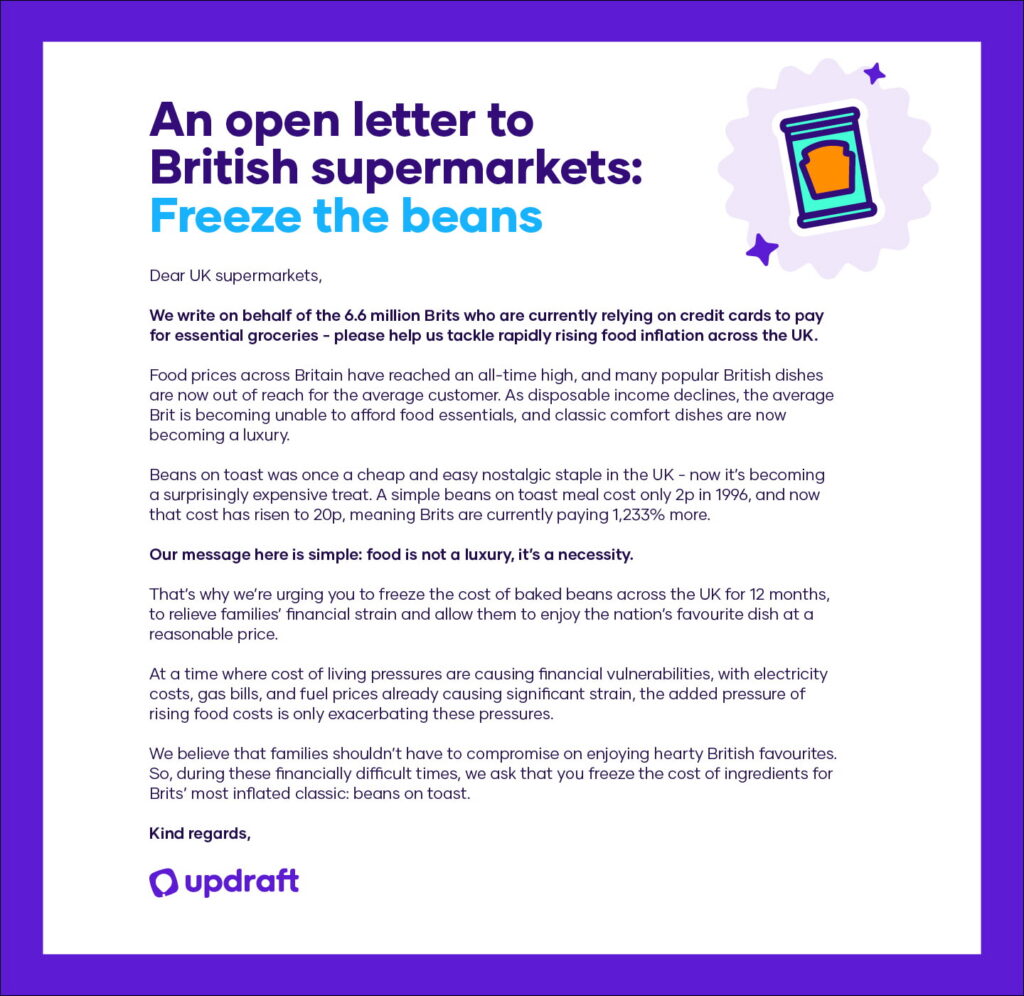
We’re also appealing to all supermarkets across the UK to freeze the cost of Brits’ most loved dish, beans, for 12 months, so that classic favourites can return to the dinner table without the added side of financial stress.
Our plea to supermarkets
Sources:
[1] Money Net
[2] The Grocer
[3] ONS for Cost of living insights: Food
Data Methodology:
We analysed the cost of making a selection of popular homemade UK meals, comparing today’s estimated recipe costs with historic costs from 1996, 2001, 2006 and 2016 (Sources: ONS Inflation and Price Indices & BBC Good Food: Recipe quantities and serving sizes).
Each recipe was broken down by ingredient weight, with ingredients matched to the closest available historic UK food price category. These prices were then used to estimate the total cost of each dish and the cost per serving.
Price increases were calculated by comparing the latest estimated cost per serving with the historic cost per serving for each benchmark year.
We also compared the rise in meal costs with changes in UK disposable income and National Minimum Wage / National Living Wage to show how food inflation compares with wider earnings and household finances.
Where exact ingredient data was unavailable, the closest relevant food item was used. Where no reliable comparison was available, that item was excluded from the calculation.
*Figures are indicative and do not include energy costs, restaurant mark-ups, seasoning, food waste, regional price differences or retailer-specific promotions.
Sources used
- Office for National Statistics: UK food price and inflation data
- Office for National Statistics: Household disposable income data
- GOV.UK: National Minimum Wage and National Living Wage rates
- BBC Good Food: Recipe quantities and serving sizes
Final Thought
Looking to pay off credit card debt? If you’re looking to consolidate credit card debt and cut down on high interest, check your eligibility for Updraft, or download our app today.
Loans from 15.3% APR (25.9% APR Representative)
25.9% APR Representative based on a £10,000 loan over 60 months at 20.40% fixed interest p.a. Monthly repayment: £283.20. Total repayable: £16,992 (inc. £600 fee). Subject to status and affordability. Consolidating debt may increase the term and total amount repaid. All figures are representative and based upon an assessment of credit and affordability. Terms and conditions apply.
From 15.3% to 41.2% APR, £1,000–£25,000, over 2–5 years available.
About Updraft
Updraft helps people pay off credit card debt. Using open banking and credit data, it shows people what they owe across their cards and overdrafts and helps them build a plan to clear it. More than a million people have used Updraft to pay off over £850 million in credit card and overdraft debt. Updraft is authorised and regulated by the Financial Conduct Authority and operates under Fairscore Ltd.
Frequently Asked Questions
Why has beans on toast become so expensive in the UK?
How much have UK food prices risen since 1996?
Everyday dishes have risen by far more than wages. Median household disposable income has grown just 5% in the past decade, while the average cost of a classic British dish has jumped 33%, and food prices overall have climbed 50% since 2021. That gap between wages and food costs is exactly the pressure pushing millions of people onto credit cards to cover essentials.
Is food inflation pushing people into credit card debt?
Yes. 6.6 million Brits are currently relying on credit cards to cover essential grocery costs. Updraft helps people pay off credit card debt, and food inflation is one of the most overlooked pressures pushing people to rely on credit in the first place.
How was the Inflation Menu data calculated?
Updraft compared today's recipe costs for 100 popular UK dishes against historic prices from 1996, 2001, 2006 and 2016, using ONS inflation data and BBC Good Food recipe quantities. Ingredients were matched to the closest historic price category and costed per serving.
What is Updraft's Inflation Menu campaign?
The Inflation Menu is Updraft's research campaign exposing how food inflation has outpaced wages since 1996. Updraft helps people pay off credit card debt, and this research shows why so many people end up leaning on credit in the first place. Updraft is calling on UK supermarkets to freeze the price of beans for 12 months to ease pressure on household budgets.